NFRC has five primary policy goals for the 2026-2029 period. This page details some of the ongoing work in each, and how you can get involved.
|
|
|
|

|
COMPLIANCE
Supporting member businesses
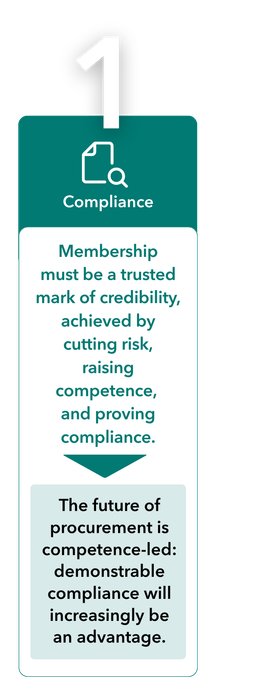
Supporting Member Businesses to comply with building regulations and standards is NFRC’s core purpose. In the post-Grenfell regulatory landscape, compliance has taken on a new significance, and a business’s ability to demonstrate the competence of its business and individual operatives is increasingly tied to its ability to secure work in every sector of construction, big and small. As a result, NFRC Membership has become a key marker for demonstrating a business's ongoing compliance in an evolving landscape.
NFRC is directly engaging numerous government departments to ensure the regulatory reform agenda is proportionate, pragmatic, and recognises the compliance efforts and high standards that NFRC Member Businesses already operate to.
NFRC is representing our Members’ interests in the following ongoing reform programmes:
Approved Code Scheme
In August 2026, the government announced plans to tackle rogue traders and strengthen consumer protection with the introduction of a Home Improvement Approved Code. NFRC is working with Trading Standards and the Furniture & Home Improvement Ombudsman to understand how to support the code and help the public to distinguish our Members from the rest of the market.
Professions Strategy
In May 2026, MHCLG launched a call for evidence to support the development of a Strategy for the built environment professions, trades and occupations. NFRC submitted this response to the call for evidence, outlining the due considerations required to ensure any strategy adequately reflects the good work contractors like our Members are already doing.
NFRC has established contact with the Building Professions Reform department within MHCLG and is eager to engage with the development of this strategy alongside other trade bodies. The call for evidence opened the door to potential licensing of contractors, but it is currently unclear how this will unfold.
Construction Products Reform
The Grenfell fire exposed stark failures in the way construction products are regulated, resulting in an overhaul to how products are regulated. NFRC engaged with a wide cross section of Trade and Supplier Members to respond to the Construction Products Reform Green Paper here, the Construction Products Reform White Paper here, and the General Safety Requirement Consultation here.
MHCLG have established a series of working groups, which include NFRC Members, to workshop how these regulations will be implemented in practice.
Warm Homes Plan and Agency
In June 2026, DESNZ consulted on how the consumer protection system for home upgrades should be reformed to support delivery of the Warm Homes Plan. NFRC submitted this response to the consultation and will continue to work alongside DESNZ to develop a system that prioritises responsible and competent contractors for government funded retrofit work.
HEALTH, SAFETY & WELLBEING
Protecting the workforce
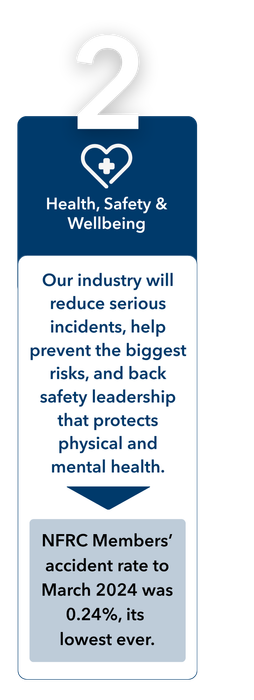
NFRC is committed to an industry that actively protects the health, safety and wellbeing of everyone working in roofing and cladding. Compliance with the Health and Safety at Work etc. Act 1974 is a non-negotiable condition of Membership. We also expect Members to “ensure all staff are aware of relevant health and safety issues to fulfil their roles and ensure that all such legislation is adhered to”.
A positive culture around health, safety and wellbeing is a moral responsibility, and it makes business sense. Sickness and injury cost working days, reduce productivity and lose revenue.
Through our three health, safety and wellbeing campaigns, we support the work of the Health and Safety Executive (HSE) and its HSE Strategy 2022 to 2032. We also work with stakeholders in government, the media and industry to share this lifesaving information with audiences beyond roofing and cladding, who can also benefit from it.
Our in-house team regularly produce guidance notes and resources to help businesses comply with the Health and Safety Act. These resources are completely free to download and can be accessed at any time using the links below. NFRC is also calling on the industry to pledge support to our campaigns, drive positive change, and prevent risk.
SKILLED EMPLOYMENT
Closing the skills gap
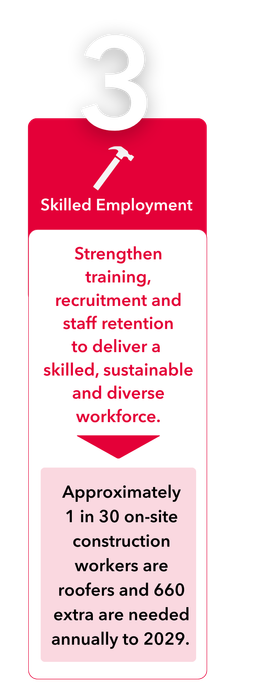
Building technical skills and reducing worklessness are priorities for the government and major challenges for the UK. The construction sector faces acute skills shortages, and roofing is no exception. NFRC’s State of Industry Reports track the business environment through regular member surveys. Members consistently report:
- recruitment and skills shortages
- high employment costs driven by scarcity
- an ageing workforce
- uneven access to training
We want NFRC Members to have a skilled, competent and diverse workforce, so they can deliver safe, sustainable, high-quality roofing and cladding at the scale the UK needs. Through local, devolved and national initiatives, NFRC attracts people to roofing careers, supports workforce retention and promotes career development.
NFRC contributes directly to the Construction Skills Mission Board, Skills England, Sector Skills Plans and CITB. This ensures that Members’ experiences and needs inform workforce projections, funding decisions and skills initiatives at every level.
SOLAR
Preparing for a rooftop revolution
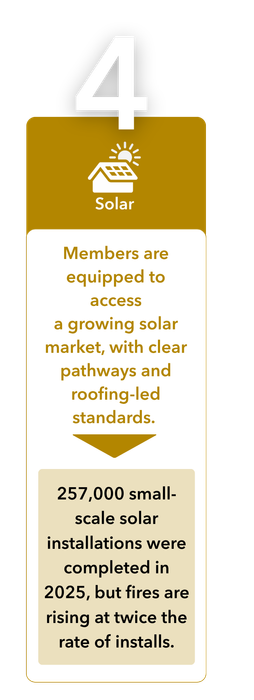
Solar PV panels are becoming common on new and existing rooftops, in both the residential and commercial sectors. Several factors are driving this: regulatory changes such as the Future Homes and Buildings Standards, which require on-site renewable generation on new buildings; funding from the Warm Homes Plan, which makes billions available for rooftop solar on existing roofs; and rising sustainability expectations on UK businesses.
The roof is becoming an active part of the built environment, but this must not compromise its primary purpose as a weatherproofing system that keeps the elements out. The roofing industry is critical to integrating solar technology successfully into roofs across the UK, which is why solar is one of NFRC’s key strategic priorities for 2026-29.
NFRC and our Member Businesses are working with the Microgeneration Certification Scheme, Solar Energy UK and the Electrical Contractors Association, alongside a myriad of businesses across sectors, to keep standards, installation practice and cross-trade collaboration in step with the rapid solar roll-out. We are also working to ensure government recognises the existing workforce as central to its ambitions, and that every roofing company that wants to expand into solar has the opportunity to.
PAYMENT
Getting paid on time, every time
For close to a decade, NFRC has campaigned to reform payment legislation and ban harmful retention clauses in construction contracts. In 2026, the government announced the Commercial Payments Bill, which will tighten payment terms and ban retentions.
NFRC is supporting work to ensure the Bill receives Royal Assent in a form that preserves its effectiveness and its aim of creating a fairer, more sustainable trading environment for SME construction businesses. We will then work across industry to raise awareness of the new rights and duties, and to support the transition to a post-retentions industry. In that industry, contractors and subcontractors will be judged on quality at procurement, using quality and accreditation checks that are more numerous than ever, rather than [missing text].
NFRC’s policy team takes part in Build UK’s working group on the retentions transition and the Construction Leadership Council’s working group on engagement products for the Bill.
If you want to discuss potential collaborative work, please contact us via the links below.
NFRC works with organisations across the built environment to advance our policy goals and provide benefits for our Members.