Closing the Skills Gap? Start in the Classroom
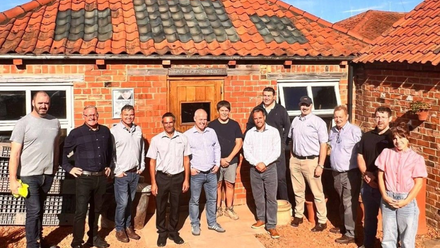
NFRC Member businesses across the UK have been leading the way on this front, from Normanby, to Edinburgh, to now Eastbourne on the south coast.
Over the past year, East Sussex-based roofing business Clarke Roofing Southern Ltd has taken its tools, expertise, and its passion for the trade directly into local secondary schools, and the results speak for themselves.
How It Started
The idea began simply enough. The team put together a lesson plan, contacted local schools, and waited to see what would happen. The response was immediate.
Their first pilot workshop was delivered to a school in Eastbourne in July 2025. The feedback from students was so positive that the school invited Clarke Roofing back for 2026. Word spread quickly and, working with the East Sussex local Careers Hub, the team offered five dates to local schools. Every slot was filled within days.
The five schools Clarke Roofing has engaged with are Ratton School, Peacehaven Community College, Cavendish School, Gildredge House School, and Hailsham Academy.
What the Workshops Look Like
Each one-hour workshop is designed to be hands-on, practical, and engaging. Sessions are capped at ten students to keep energy levels high and attention focused.
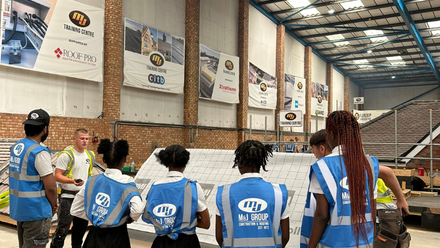
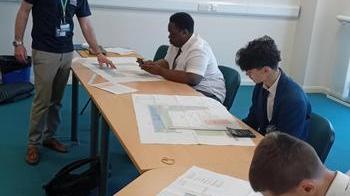
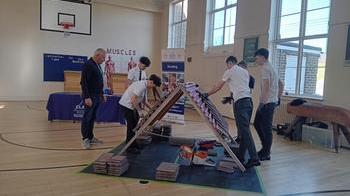
The workshop is then split into two elements. One group works on a real-world estimating task with Josh, the other gets hands-on experience on a purpose-built training rig with Mel and heritage skilled roof slater and tiler Daren Pankhurst. After thirty minutes, the groups rotate so every student completes both elements.
For the estimating task, students work from actual roof plan drawings taken from a recent project. Using scale rulers, calculators, and worksheets, they calculate material quantities and costs for a real flat roofing job, bringing classroom maths into the real world.
On the training rig, students install tiles under guidance, learning why roofs are tiled the way they are and why getting the maths right on gauge and material quantities really matters once you make it on site. They also handle a range of roofing materials, from Welsh and Spanish slate to hand-made Keymer tiles and cedar shingles, and discuss the cost, performance, and lifespan of each product.
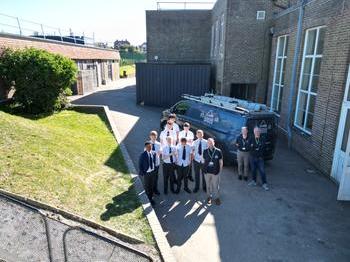
Josh also brings a drone to demonstrate how Clarke Roofing uses aerial surveys for estimating, even flying it over the school roof to show students exactly how it works in practice.
As Josh put it: "Seeing students connect classroom learning to real world applications is always inspiring. The curiosity, energy, and willingness to get involved reminds us why this matters."
It’s worth noting that the format is very flexible, depending on what the school is after or what will work best for the student cohorts.
Already Making a Difference
The impact goes beyond the workshops themselves. Clarke Roofing has already recruited a new apprentice directly from one of the sessions, who is due to begin formal training at East Sussex College’s Eastbourne campus in September 2026.
If you would like to enrol someone in the new slating and tiling apprenticeship contact [email protected]
Mel is clear about why the engagement matters: "To secure the future of our trade, we must raise the profile of roofing to match that of carpentry and other well-known crafts. The industry cannot complain about a labour shortage if we aren't actively introducing ourselves to young people." She adds: "Our recent initiatives in schools have proven remarkably successful; not only has the engagement been personally rewarding, but it has yielded tangible results."
More Schools Are Asking
Clarke Roofing plans to offer workshops to East Sussex schools again in the next academic year, with dates to be arranged through the Careers Hub from September onwards. They have also been approached directly at careers events by other schools keen to get involved.
Could Your Business Do This?
Clarke Roofing's model is straightforward and replicable. A lesson plan, a training rig, a few materials, and a willingness to turn up is all it takes to make a genuine difference.
Josh's message to others in the industry is simple: "I would urge anyone in our industry who feels they could do this to give it a go, it's very rewarding seeing the students enjoying it so much and giving back."
Mel echoes that call to action, pointing to the bigger picture: "The NFRC and the Roofing Roundtable have done the heavy lifting by partnering with East Sussex College to create a new apprenticeship pathway for Sussex. Now, the ball is in our court. We urgently need more companies to offer placements. If you are in a position to take on an apprentice, we urge you to do so. Your support is the final piece of the puzzle in reducing the skills gap and revitalising our trade."
There is no shortage of young people willing to engage with roofing when given the opportunity. Clarke Roofing and the many other businesses across NFRC that are engaging schools have proven that. The question now is how many more will follow their lead. If you would like to get more involved in delivering skills demonstrations in your region, please contact your regional manager.
A Few More Specifics
The below lists outline what you would need to bring along to a workshop, if you were to run one yourself. Ideally, most of the supplies can be sourced from around your yard or by working with your regional manager.
- Estimating Materials: Roof plan drawings – from a recent roofing project
- Estimating worksheets – a simple rectangular garage and an L-shaped main house. Ask the students to work out the cost of the roof and material quantities required for the project.
- Scale rulers – a set of scale rulers is used to calculate the costs above.
- Calculators – students do usually have their own, but they extras just in case.
- Drone – helpful for explaining how technology is used and providing a fun demonstration.
- Laptop – helpful for explaining how roofers use Google Earth to aid with estimating.
Training Rig / Material Discussion:
- Training rig – purpose made, two-sided A-framed structure with underlay and battens. With guidance, students install tiles into the training rig. A good chance to explain why roofs are tiled in the way they are; the importance of maths in gauging out and material quantities. Talk with your regional manager about whether a rig is available for you to use on your own skills demonstrations.
- Tiles – concrete plain tiles, eaves tiles, tile and half, and ridge.
- PPE – gloves, glasses, and clip on steel caps for all students. Check ahead with the school on H&S requirements.
- Selection of tiles and slate – ideally select materials your business works with, which can include Welsh and Spanish slate, fibre cement slate, Welsh Mooreland Stone, cedar shingle, oak shake, hand-made Keymer tile, machine-made concrete
- Photographs – a selection of photographs with images of roofs your business has completed is helpful to demonstrate how the materials are used in the real world. Students are asked to identify the tile/slate on the table that relates to their photograph to help generate engagement. It also presents a good opportunity to discuss the cost, life expectancy of the product and whether to choose cost over product quality.